Tel Aviv, Israel – Israel on Wednesday appointed its first ambassador to Somalia’s breakaway region of Somaliland, further deepening a diplomatic dispute with Mogadishu just months after becoming the first country to formally recognise the breakaway republic.
The Israeli foreign ministry said veteran diplomat Michael Lotem had been appointed non-resident ambassador to Somaliland. Israeli media said Lotem previously served as Israel’s ambassador to Kenya, Azerbaijan and Kazakhstan.
The appointment follows Israel’s announcement on December 26, 2025, when it officially recognised Somaliland as an “independent and sovereign state.”
The move marked a major break from more than three decades of international non-recognition and drew swift condemnation from Mogadishu and several other countries.
The move is likely to further infuriate Somalia’s federal government, which considers Somaliland part of its territory and has repeatedly condemned direct foreign engagement with authorities in Hargeisa as a violation of its sovereignty.
Following Israel’s recognition in December, Somalia moved quickly to rally diplomatic opposition.
A joint statement coordinated by Somalia’s foreign ministry, which included Egypt, Algeria, Djibouti, Nigeria, Pakistan, Saudi Arabia and Turkey, rejected the decision and reaffirmed support for Somalia’s territorial integrity.
Fierce backlash
The African Union also responded strongly, underscoring longstanding continental concern over any challenge to inherited state borders.
In a January 6 communiqué, the AU Peace and Security Council said Israel’s unilateral recognition of the “so-called Republic of Somaliland” threatened Somalia’s sovereignty, unity and stability.
The council called for the decision to be revoked, stressing that no external actor had the authority to alter the borders of an AU member state.
It reiterated that position in February, warning that the move risked setting a precedent for separatist claims elsewhere on the continent.
Somaliland, however, has long argued that its claim to statehood is distinct. The territory traces its case back to June 26, 1960, when the former British Somaliland gained independence.
It existed as a sovereign state for five days before uniting with the former Italian-administered south to form the Somali Republic.
After the collapse of Siad Barre’s regime in 1991, Somaliland declared that it was restoring that earlier independence.
For more than three decades, it has operated with its own government, currency, parliament and security forces, while the internationally recognised government in Mogadishu has exercised no direct authority there.
Red Sea geopolitics
Somaliland’s search for international recognition has gained momentum in recent years, as its strategic location has drawn increasing international interest.
Positioned on the Gulf of Aden near the Bab al-Mandeb strait, one of the world’s busiest maritime corridors, the territory has presented itself to foreign partners as a relatively stable foothold in a volatile region.
The diplomatic push has unfolded against a wider backdrop of insecurity in the Red Sea and the Horn of Africa, where shipping routes, port access and regional alignments have taken on renewed strategic importance.
Somaliland’s geopolitical positioning previously triggered a major regional dispute in January 2024, when it signed a memorandum of understanding with Ethiopia.
The deal offered landlocked Addis Ababa access to a stretch of coastline near the port of Berbera in exchange for the prospect of formal recognition.
Somalia rejected that agreement as illegal, and President Hassan Sheikh Mohamud later signed a law nullifying it.
The dispute triggered a sharp diplomatic crisis between Mogadishu and Addis Ababa, though both sides later moved to ease tensions through Turkish mediation.
Moving to working ties
While Ethiopia stopped short of formal recognition, Israel’s move late last year handed Hargeisa the diplomatic breakthrough it had sought for decades.
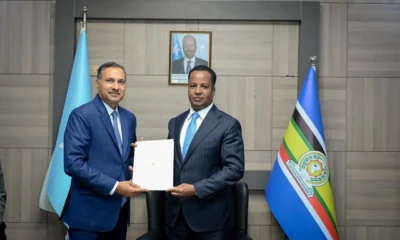
In February, Israel formally accepted the credentials of Somaliland’s first ambassador, Mohamed Hagi, signalling that reciprocal appointments would follow.
Wednesday’s appointment of Lotem completes the next step and suggests that both sides are moving from symbolic recognition toward formal diplomatic ties.
Israel has said the relationship could open the way for broader cooperation in areas such as security, technology, health, and agriculture.
The development is also a significant foreign policy gain for Somaliland President Abdirahman Mohamed Abdullahi, known as Irro, who took office in December 2024 after defeating incumbent Muse Bihi Abdi in an election that Somaliland presented as further proof of its democratic credentials.
But for Mogadishu, the growing Israeli-Somaliland relationship touches a central question of statehood and sovereignty. Somalia continues to insist that Somaliland remains part of the Somali state, while most regional and international actors still back that position.
Wednesday’s ambassadorial appointment, therefore, goes beyond a routine diplomatic posting.
It marks another step in Israel’s effort to turn recognition into formal ties, and another challenge to the international consensus that has, until now, denied Somaliland the statehood it has pursued since 1991.